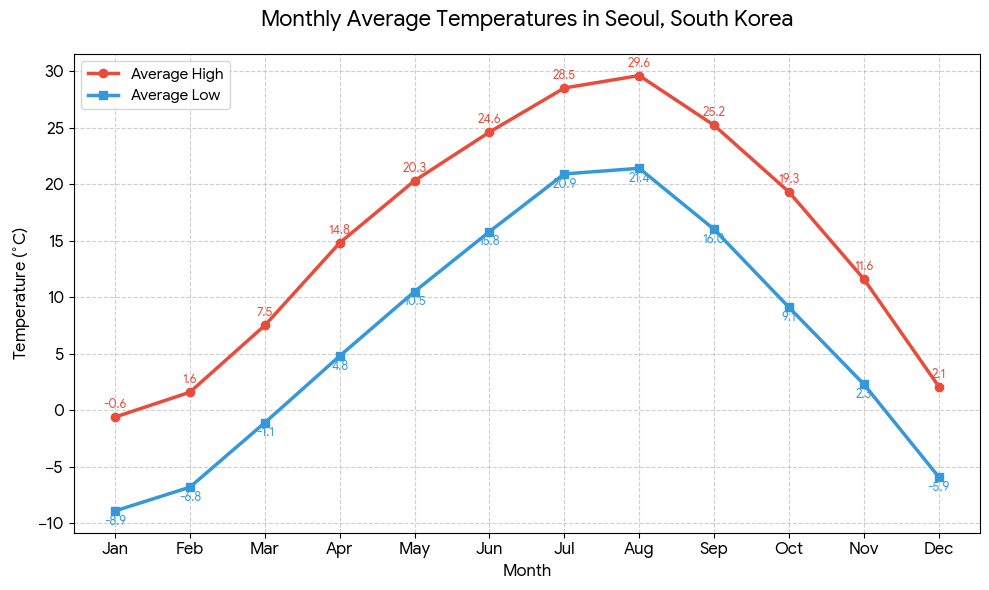
South Korea has a temperate climate with four distinct seasons, featuring hot, humid summers influenced by East Asian monsoons and cold, dry winters driven by Siberian air masses.
Overview of Seasons
| Season | Months | Temperature Range | Weather Characteristics |
|---|---|---|---|
| Spring | March – May | 0°C to 24°C (33°F to 75°F) | Warm, sunny, cherry blossoms; occasional yellow dust storms. |
| Summer | June – August | 18°C to 30°C+ (64°F to 86°F+) | Hot, intensely humid; heavy monsoon rains (Jangma) in July. |
| Autumn | September – November | 2°C to 26°C (36°F to 79°F) | Crisp air, clear skies, low humidity, and vibrant fall foliage. |
| Winter | December – February | -7°C to 5°C (20°F to 40°F) | Freezing, very dry, windy; snowfall occurs mainly in the north and east. |
Key Climate Elements
- The Monsoon (Jangma): Roughly 50-60% of South Korea’s annual rainfall occurs during the summer monsoon season, typically lasting from late June through July.
- Regional Variances:
- Southern Coast & Busan: Temperatures average 3°C to 5°C warmer than Seoul during the winter. Winters are much milder, and snow is rare.
- Jeju Island: The warmest region in Korea. Winter lows rarely drop below freezing at sea level, but it experiences higher overall rainfall and wind year-round.
- Gangwon Province in the northeast receives massive winter snows ideal for skiing.
- Best Times to Visit: Spring (April-May) and Autumn (September-November) are universally considered the best travel windows due to mild temperatures and minimal rainfall.
Comparison of the differences between coldest month average temperature
and hotest month average temperature of major cities.
| Ranking | City | Average lows /January | Average Highs / Jul,Aug | Average Differences |
|---|---|---|---|---|
| 1 | Beijing | -6.9℃ | 31.8℃ | 38.7℃ |
| 2 | Seoul | -5.5℃ | 29.8℃ (8월) | 35.3℃ |
| 3 | New York | -2.8℃ | 29.4℃ | 32.2℃ |
| 5 | Rome | 3.3℃ | 31.7℃ | 28.4℃ |
| 6 | Paris | 2.7℃ | 25.2℃ | 22.5℃ |
| 7 | London | 3.1℃ | 22.6℃ | 19.5℃ |
Current Weather Info by Korea Meteorological Administration
 Since global warming has worsened, South Korea’s summers—especially from late July to mid-August—frequently experience extreme heat, making travel during this period quite uncomfortable